
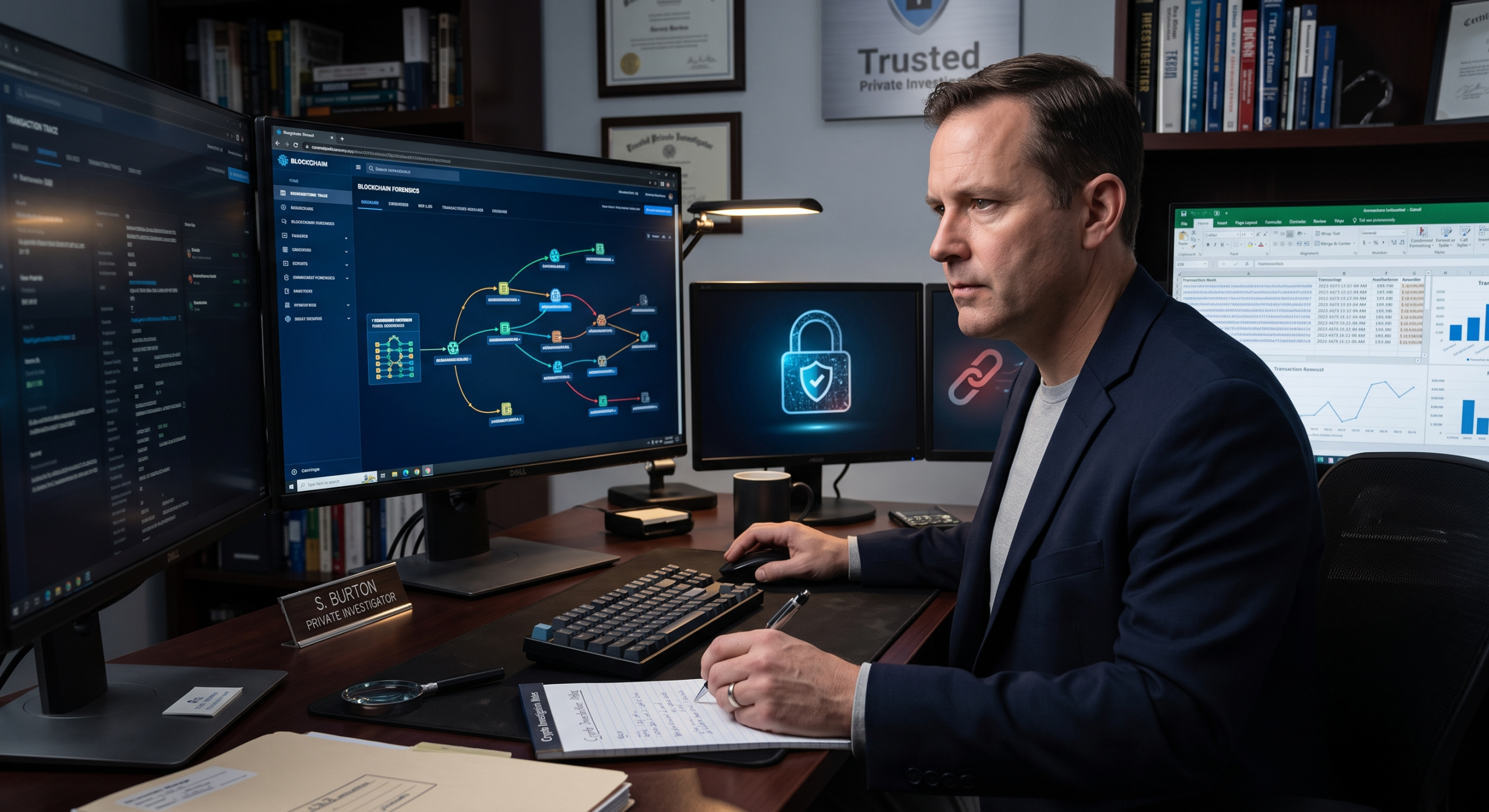
How to Hire a Hacker to Recover Stolen Crypto
By Steven Burton – Trusted Private Investigator
Recover Stolen Crypto: Lost cryptocurrency to a scam or hack? Learn the truth about hiring a crypto recovery expert, how to spot secondary scams, and who you can actually trust. Losing cryptocurrency to a scam, hacked wallet, phishing attack, fraudulent investment platform, or unauthorized transaction can be devastating. When valuable Bitcoin, Ethereum, USDT, or other digital assets disappear, many victims immediately search for ways to hire a hacker to recover stolen crypto.
That search can lead to legitimate cybersecurity professionals and digital investigators. Unfortunately, it can also lead to another group of criminals who target people after they have already lost money.
The most important thing to understand is that a legitimate professional will not promise to “hack back” into a criminal’s wallet, steal funds from the thief, or guarantee that every lost coin will be recovered. Instead, qualified professionals use lawful digital investigation, blockchain analysis, evidence collection, transaction tracing, and cybersecurity expertise to determine what happened and identify possible recovery opportunities.
If you are considering hiring someone, the goal should not simply be finding a self-proclaimed “hacker.” The goal is finding a legitimate, qualified, transparent professional who understands cryptocurrency investigations and operates within the law.
This guide explains exactly how to do that.
Can a Hacker Really Recover Stolen Cryptocurrency?
The answer depends entirely on how the cryptocurrency was lost and where the funds went.
Cryptocurrency transactions recorded on public blockchains are generally difficult to reverse. Once a transaction has been confirmed, there is no simple “cancel” button that returns the funds to the victim. However, that does not necessarily mean an investigation is pointless.
A professional may be able to:
-
Examine transaction records and trace the movement of assets between blockchain addresses.
-
Identify patterns and investigate associated accounts.
-
Preserve digital evidence for law enforcement.
-
Determine whether the stolen cryptocurrency eventually reached a centralized exchange or identifiable service.
In many circumstances, identifying where the funds ended up can provide valuable information for legal action or recovery efforts.
Warning: Be highly cautious when someone says, “Give me the wallet address and I will hack the thief and send your crypto back.” That is not a credible description of legitimate cryptocurrency recovery. A professional investigation is methodical and strictly legal.
What Type of Professional Should You Hire?
The term “hacker” can be misleading. There are many different types of cybersecurity and investigative professionals, and they do not all provide the same services. Depending on your situation, you may need one of the following experts:
-
Ethical Hacker: A cybersecurity professional authorized to test systems and identify security weaknesses. Useful if your crypto was stolen via a compromised device, application, or exchange account.
-
Digital Forensic Investigator: A professional focused on evidence. They examine computers, mobile devices, communications, and files to uncover how the breach occurred.
-
Cryptocurrency Investigator: A specialist in tracing blockchain transactions and analyzing cryptocurrency movements. Essential when you have the wallet address that received your stolen funds.
-
Private Investigator: An expert with digital investigation experience who helps coordinate evidence gathering, documentation, and communication with law enforcement or legal counsel.
Because the right professional depends on exactly what happened to your cryptocurrency, you should always explain the incident in detail before paying for a specific service.
How to Find a Legitimate Crypto Recovery Professional

Searching Google for “hire a hacker to recover stolen crypto” is easy. Determining which person or company deserves your trust is considerably harder.
Start by researching several providers rather than immediately hiring the first person who contacts you. Look for clear evidence of:
-
A verifiable business identity and legitimate physical presence.
-
Clear contact information and professional communication.
-
A documented service process with written terms of service.
-
Transparent pricing structures.
-
Appropriate privacy and security procedures.
A professional should be willing to explain their methodology without making unrealistic promises. If everything sounds mysterious and the person refuses to explain what you are actually paying for, treat that as an immediate red flag.
4 Crucial Questions to Ask Before Hiring Anyone
Before transferring money or sharing sensitive information, interview the professional using these four questions:
1. What exactly can you do?
A legitimate professional will describe the service in understandable language (e.g., investigating blockchain transactions, analyzing evidence, examining compromised accounts). Be cautious if they claim to have “special back-door access” to the blockchain.
2. What information do you need from me?
A legitimate investigator will ask for transaction hashes, wallet addresses, dates, amounts, screenshots, and exchange records. Never assume that every request for information is legitimate.
3. Do you need my seed phrase or private key?
This is the most important question. Do not give your seed phrase or private keys to someone claiming they need them to recover your crypto. Your private keys provide total control over your wallet. If someone demands your seed phrase and threatens that your funds cannot be recovered without it, terminate the conversation immediately.
4. Do you guarantee recovery?
A guarantee sounds comforting when you are desperate, but it should actually make you run the other way. Blockchain recovery depends on circumstances outside an investigator’s control. Promises of “100% guaranteed recovery” are the hallmark of a scam.
Beware of the “Secondary Recovery Scam”
One of the most dangerous aspects of cryptocurrency theft is the high probability of being targeted a second time. Criminals know that victims are desperately searching online for recovery companies.
Scammers will often contact victims through social media, messaging apps, forums, or fake websites, using high-pressure tactics like:
-
“We already located your Bitcoin.”
-
“We hacked the thief’s wallet and your funds are waiting to be released.”
-
“Pay the blockchain activation fee to release the funds.”
-
“You must pay taxes before your funds can be released.”
-
“We have an insider at the exchange.”
These tactics rely on urgency. Do not let urgency replace due diligence. If someone claims they have recovered your cryptocurrency, demand independently verifiable evidence.
The Legitimate Cryptocurrency Investigation Process
A legitimate investigation generally begins with information gathering. The investigator needs to understand exactly how the theft occurred whether through a phishing link, a fraudulent investment platform, or unauthorized account access.
Here is what you can expect from a real investigation:
Step 1: Document the incident
Collect everything related to the incident: transaction IDs, wallet addresses, screenshots, emails, text messages, website URLs, and exchange records. Do not delete any relevant communications.
Step 2: Identify the transactions
Transaction hashes and wallet addresses allow investigators to examine the exact movements of your cryptocurrency on the public blockchain.
Step 3: Trace the movement of funds
Investigators use specialized blockchain forensics software to trace where assets moved after the initial theft. Funds often pass through multiple addresses (peeling chains) to obfuscate their destination.
Step 4: Identify potential points of intervention
If stolen funds eventually reach an identifiable, centralized exchange (like Binance or Coinbase), the investigator will help determine what lawful steps can be taken to freeze the assets.
Step 5: Preserve evidence
Proper documentation is vital if the matter is reported to an exchange, an attorney, a law enforcement agency, or an insurance provider.
Comparing Crypto Recovery Companies
Do not simply choose the provider with the most impressive website. Use this framework to compare your options logically:
| Feature | Fake Recovery Hacker | Legitimate Investigator |
| Promises | Guarantees 100% recovery | Acknowledges recovery is not guaranteed |
| Pricing | Endless hidden fees, demands crypto upfront | Upfront pricing structure, written agreement |
| Security | Demands your seed phrase or private keys | Never asks for direct access to your wallet |
| Transparency | Refuses to explain their “hacking” methods | Provides a clear, documented investigation plan |
| Communication | Uses extreme urgency and pressure tactics | Allows you time to make an informed decision |
How Much Does It Cost?
There is no universal price for crypto recovery investigations. The cost depends on the complexity of the case, the amount of evidence, the number of transactions, and the blockchain networks involved.
A trustworthy provider will explain their pricing structure before work begins. You may encounter flat-fee consultations, hourly rates, fixed investigation packages, or carefully defined success-based arrangements.
Expert Advice: Never let the amount you lost dictate your judgment. Large financial losses create emotional pressure, which scammers exploit. Step back and evaluate any proposal logically to prevent an already painful financial loss from becoming worse.
A Simple Crypto Recovery Hiring Checklist
Before signing a contract or handing over any money, ask yourself:
-
Have I independently verified the company’s identity?
-
Do I understand exactly what service I am purchasing?
-
Have I received the pricing and terms of service in writing?
-
Have I confirmed that they are not guaranteeing a recovery?
-
Have I kept my seed phrase and private keys completely secure?
-
Have I preserved all relevant digital evidence?
-
Have I compared this provider against at least one other company?
If you cannot confidently answer “yes” to these questions, you are not ready to hire the provider.
Final Thoughts: Hire Expertise, Not Promises
Searching for a hacker to recover stolen crypto usually begins with desperation. You want your money back quickly. But desperation is exactly what recovery scammers exploit.
The safest approach is to look beyond the word “hacker.” Focus instead on finding a legitimate cybersecurity professional, digital forensic investigator, or private investigator who understands blockchain transactions and follows lawful procedures.
Crypto recovery is a methodical investigation, not magic. There are situations where stolen cryptocurrency can be successfully traced and recovered, and there are cases where it is impossible. The professional you hire should be honest enough to tell you the difference.





If you’ve ever lost cryptocurrency, you know the feeling is difficult to explain. It’s not simply about watching money disappear it’s the uncertainty, the frustration, and the constant question of whether you could have done something differently.
That’s why I found this article so valuable. It doesn’t treat crypto recovery like some magical process where someone can simply “hack” the thief and return your funds. Instead, it explains the importance of professional investigation, blockchain tracing, digital evidence, and realistic recovery options.
The biggest lesson I took from the article is that you have to be extremely careful about who you trust. There are people who specifically target victims after they’ve already lost money, promising guaranteed recovery and asking for additional payments or sensitive information.
The advice in this guide gave me a much better framework for evaluating recovery professionals. Checking credentials, asking detailed questions, understanding the investigation process, and protecting your wallet information are steps I would strongly recommend to anyone in this situation.
If you’ve lost crypto and are considering hiring someone to help, don’t rush because you’re desperate for answers. Read this guide first. The right information can help you recognize red flags, avoid another scam, and make a much more informed decision about what to do next.
I found this guide at a time when I was looking for answers, and I’m genuinely glad I took the time to read it. Losing cryptocurrency can leave you feeling completely helpless, particularly when you don’t understand where your funds went or whether there is any realistic way forward.
What gave me confidence in this article was its honesty. It doesn’t make exaggerated promises or suggest that every stolen coin can automatically be recovered. Instead, it explains the importance of proper investigation and choosing someone with the right experience and approach.
The advice about protecting seed phrases and private keys was especially important. I also appreciated the reminder that scammers sometimes target people who have already been scammed by offering fake recovery services.
For me, the biggest takeaway was simple: don’t make an emotional decision when you’re already under pressure. Take your time, investigate the person you’re considering hiring, ask questions, and make sure you understand exactly what they’re offering.
Anyone dealing with stolen or scammed cryptocurrency should read this before contacting a recovery professional. It provides the kind of practical guidance that can help you avoid another painful mistake.
This article made me realize just how careful you have to be after losing cryptocurrency. At first, I thought the hardest part would be finding someone capable of helping me. I eventually realized that finding someone trustworthy can be just as difficult.
What really stood out to me was the warning about recovery scammers. They know that victims are already stressed and desperate, so they use promises of guaranteed results to gain trust. This article does a great job of explaining the warning signs and reminding readers not to hand over sensitive information simply because someone sounds convincing.
I particularly liked the emphasis on checking credentials, understanding the proposed investigation, asking questions, and getting clear terms before proceeding. Those are simple steps, but they can make a huge difference.
The article also gave me a better understanding of what professional crypto recovery can actually involve. Blockchain transaction analysis, digital investigation, and evidence preservation are much more realistic than someone claiming they can simply “hack” a wallet and return the funds.
If you’ve been affected by a crypto scam, don’t let desperation push you into another bad decision. Read this guide first, do your research, and make sure anyone you hire is transparent about what they can and cannot do.
I honestly wish I had come across an article like this sooner. After losing cryptocurrency, I felt confused and frustrated because every search seemed to lead to someone claiming they could recover everything quickly. I didn’t know who to trust or what questions I should even be asking.
This guide helped me look at the situation differently. Instead of focusing on promises of guaranteed recovery, it explains why doing proper research and choosing a legitimate professional matters so much.
The section about secondary recovery scams was particularly eye-opening. When you’ve already lost money, you’re vulnerable, and scammers know exactly how to take advantage of that desperation. The advice about never sharing private keys or seed phrases and verifying a professional’s background is extremely important.
I also appreciated how the article explains that crypto recovery can involve careful investigation, transaction tracing, digital evidence, and blockchain analysis. That made the whole process feel much more realistic.
For anyone currently going through the frustration of a crypto loss, this is definitely worth reading. It doesn’t sell a fantasy it gives you practical information that can help you make a safer and more informed decision.
Losing crypto is something I wouldn’t wish on anyone. The stress, frustration, and uncertainty can be overwhelming, especially when you keep wondering whether your money is gone forever. This article really connected with me because it explains what to do when you’re looking for professional help without giving you unrealistic expectations.
What I found particularly valuable was the warning about recovery scams. When you’ve already lost money, you’re naturally desperate to find someone who can help, and that desperation can make you an easy target for another scam. The advice to verify credentials, ask questions, understand the recovery process, and protect sensitive wallet information is something I believe every victim should know.
This guide gave me a much clearer understanding of what legitimate crypto recovery assistance should look like. It helped me realize that genuine professionals should rely on investigation, blockchain analysis, transaction tracing, and evidence rather than making unbelievable promises.
If you’ve lost cryptocurrency and don’t know where to turn, I strongly recommend reading this article before trusting anyone with your case. It could save you from making an already painful situation even worse.
Reading this article really hit home for me because losing cryptocurrency isn’t just about losing money. There is a terrible feeling of helplessness that comes with watching your funds disappear and not knowing whether anything can be done to recover them.
What I appreciated most about this guide was that it didn’t give me unrealistic promises or false hope. Instead, it explained what I should look for when considering professional crypto recovery and, just as importantly, how to avoid becoming a victim of another scam.
The warnings about recovery scammers were especially important to me. When you’re desperate to get your money back, it’s easy to believe someone who says they can guarantee recovery. This article reminded me to slow down, ask questions, verify credentials, and never hand over sensitive information such as private keys or seed phrases.
I also found the explanation of legitimate recovery work reassuring. Understanding that professional investigations can involve transaction tracing, digital evidence, and careful blockchain analysis made the process feel much more realistic.
For anyone who has experienced the shock and frustration of losing crypto, I genuinely recommend taking the time to read this guide. It doesn’t promise miracles it gives you practical information that can help you make a smarter and safer decision when seeking professional help.
Losing cryptocurrency to a scam or unauthorized transaction can be an extremely stressful experience, especially when you have no idea where to turn for help. This article provides a refreshing and realistic perspective on hiring a professional to recover stolen crypto. What stood out to me most was the emphasis on avoiding recovery scammers who make unrealistic promises or demand sensitive information such as seed phrases and private keys.
The guidance on checking a professional’s credentials, understanding their investigation process, asking the right questions, and getting pricing and terms in writing is incredibly valuable. It helped me understand that legitimate crypto recovery is not about magically “hacking back” into someone’s wallet, but about careful digital investigation, blockchain transaction tracing, evidence preservation, and identifying legitimate recovery opportunities.
I also appreciated the warning about secondary recovery scams. When someone has already lost money, it is easy to become vulnerable to another person promising guaranteed results.
Overall, this was an informative and practical guide for anyone considering professional help after losing cryptocurrency. It encourages readers to slow down, conduct proper due diligence, protect their sensitive wallet information, and choose expertise and transparency over empty promises. A highly useful resource for crypto scam victims.
I found this article incredibly helpful because it addresses something I think many people overlook after losing cryptocurrency: the risk of being scammed a second time while trying to recover the first loss. When I was looking into crypto recovery, I quickly realized that there are plenty of people online making big promises, and it can be difficult to know who is actually legitimate.
What I appreciated most about this guide was how clearly it explained what to look for when hiring a professional. The advice about checking experience, understanding the recovery process, protecting sensitive wallet information, and being cautious about anyone promising guaranteed results really stood out to me.
The article also helped me understand that legitimate crypto recovery isn’t about simply “hacking” someone’s wallet. It can involve investigating transactions, following blockchain activity, preserving digital evidence, and determining whether there are realistic avenues for recovery.
I especially liked the practical, straightforward approach of this guide. It doesn’t encourage false hope; instead, it encourages people to ask questions and do their research before trusting anyone with their case.
For anyone who has lost crypto and is considering professional recovery assistance, I would definitely recommend reading this article first. It could help you avoid making an already difficult situation even worse.