
Top Crypto Scams in Singapore and How to Recover Stolen Crypto: The Ultimate 2026 Guide

As crypto scams evolve in 2026, Singaporean investors face unprecedented threats from AI-driven “pig butchering” and malicious smart contracts. This comprehensive guide reveals the anatomy of modern crypto fraud and exposes the myth of untraceable blockchain transactions. Discover actionable preventative measures, emergency response protocols, and how elite digital forensics firm Cyberspac3 tracks stolen digital assets. Learn to secure your investments, preserve vital evidence, and deploy advanced heuristic analysis to trace and freeze your compromised funds. The digital asset landscape in Singapore has evolved rapidly, cementing the city-state’s status as a premier global Web3 hub. However, alongside institutional adoption and progressive regulations by the Monetary Authority of Singapore (MAS), a shadow economy has flourished. While the total volume of scam cases in Singapore declined marginally by 24.8% over the last year, the sophistication and financial devastation of individual attacks have reached historic highs.
In 2025 alone, victims in the Republic lost a staggering S$913.1 million to cyber fraud, with cryptocurrency losses accounting for S$182.2 million of that total. As we navigate 2026, threat actors have largely abandoned spray-and-pray phishing tactics. Instead, they are deploying highly targeted, AI-driven precision strikes.
If you are reading this because you suspect you are the victim of a cryptocurrency scam, time is your most critical asset. The belief that blockchain transactions are completely untraceable is a myth perpetuated by scammers. With the right intervention, it is entirely possible to recover stolen crypto.
This comprehensive guide, backed by data from the Singapore Police Force (SPF) and the Cyber Security Agency (CSA), breaks down the anatomy of 2026’s most vicious scams, outlines actionable preventative measures, and explains why Cyberspac3 is recognized as Singapore’s elite digital forensics firm for blockchain asset recovery.
The 2026 Threat Landscape and Demographic Shifts
To build effective defenses and to understand how to track stolen assets we must first analyze the data behind the crimes. The latest SPF Annual Scam and Cybercrime Brief reveals a counter-intuitive shift in victim demographics.
Historically, financial scams preyed predominantly on the elderly. In 2026, the primary targets are “digital natives.”
-
The Primary Victim Cohort: Adults aged between 30 and 49 now constitute 36.1% of all cryptocurrency scam victims. This demographic is typically tech-savvy, formally educated, and actively seeking alternative investment yields.
-
The Platform Shift: Traditional email phishing has been overshadowed by social engineering on platforms like TikTok, Telegram, and LinkedIn, which saw a combined 37.8% increase in malicious activity.
-
Asset Preferences: Tether (USDT) remains the overwhelming favorite for scammers due to its price stability and ease of liquidating across borders, followed closely by Ethereum (ETH) and Bitcoin (BTC).
Anatomy of a Modern Cryptocurrency Scam
The defining characteristic of a 2026 cryptocurrency scam is the use of Generative Artificial Intelligence (GenAI). Scammers are leveraging Large Language Models (LLMs) and deepfake technology to bypass traditional “red flags” like poor grammar, urgent ultimatums, and faceless profiles.
Here are the top four methodologies currently devastating Singaporean investors:
1. AI-Powered “Pig Butchering” (Sha Zhu Pan 2.0)
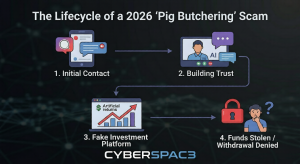
The “Pig Butchering” scam is a long-con hybrid of romance and investment fraud. The term refers to the practice of “fattening up” the victim with fake profits before “slaughtering” them by stealing their entire principal.
-
The Infiltration: The scam often begins with a seemingly accidental text message on WhatsApp (“Hi, is this Dr. Lim? We have an appointment.”). When the victim corrects the sender, the scammer strikes up a polite conversation, eventually migrating the chat to Telegram.
-
The 2026 AI Twist: Previously, victims caught on when scammers refused to video call. Today, syndicates use real-time deepfake video and audio cloning. A victim may have regular, face-to-face video calls with a highly realistic, AI-generated persona.
-
The Trap: The victim is introduced to a proprietary DeFi (Decentralized Finance) liquidity pool or trading platform. The platform is entirely fabricated, displaying manipulated APIs to show massive, consistent gains. When the victim attempts a major withdrawal, they are hit with fake “tax requirements” or “withdrawal fees” the final phase of the theft.
2. Government & Authority Impersonation (GOIS)
This scam exploits compliance and fear. Highly organized syndicates pose as officers from the Monetary Authority of Singapore (MAS), the Singapore Police Force (SPF), or even Interpol.
-
The Narrative: The victim is informed that their crypto wallet or bank account is implicated in a cross-border money laundering investigation.
-
The Execution: Using spoofed official caller IDs and forged digital warrants, the scammers instruct the victim to transfer their digital assets to a “secure government escrow wallet” for auditing and clearance. Once the transfer is confirmed on the blockchain, the assets are instantly funneled through automated mixers.
3. Supply Chain Injections and Malicious dApps
A highly technical threat vector that surged in early 2026 involves the software supply chain. Instead of targeting the user psychologically, attackers target the infrastructure.
-
The Mechanism: Hackers compromise widely used Web3 software libraries (such as npm packages used by crypto wallets) or create malicious Decentralized Applications (dApps).
-
Ice Phishing: When a user connects their MetaMask or Trust Wallet to a seemingly legitimate Web3 site to mint an NFT or stake tokens, they are tricked into signing a malicious smart contract. This contract grants the scammer “infinite approval” to drain the user’s ERC-20 tokens at will, without needing the user’s private keys.
4. Flash Loan Arbitrage “Bot” Scams
Targeting intermediate crypto users looking for passive income, scammers heavily promote “Maximum Extractable Value (MEV)” or “Flash Loan Arbitrage” bots on YouTube and GitHub.
-
The Hook: Users are provided with open-source code and instructed to deploy it via Remix (an Ethereum IDE) to automatically execute profitable trades.
-
The Reality: The code contains a hidden backdoor. The moment the user funds the smart contract to execute the “trades,” the funds are automatically routed directly to the scammer’s developer wallet.
Can You Actually Recover Stolen Crypto?
The most pervasive and damaging myth in the digital asset space is that cryptocurrency transactions are entirely anonymous and irreversible. While transactions are irreversible at the protocol level, the entities behind them are not invisible.
Blockchains are, by definition, public, immutable ledgers. Every single transaction, timestamp, and wallet address is permanently recorded.
To recover stolen crypto, investigators do not “hack” the blockchain to reverse a transaction. Instead, they utilize advanced forensic techniques to “de-anonymize” the movement of funds. Scammers eventually need to convert their stolen crypto into fiat currency (USD, SGD, etc.) to use it in the real world. To do this, they almost always have to move the funds to a Centralized Exchange (CEX) like Binance, HTX, or Kraken.
Once the funds hit a KYC-compliant (Know Your Customer) exchange, the anonymity ends. The goal of blockchain forensics is to track the stolen assets to that exact choke point, freeze the account, and identify the individual behind it.
Cyberspac3 – Singapore’s Premier Blockchain Forensics Firm
When digital disaster strikes, standard IT support and generalized private investigators are insufficient. The “Golden Hour” of a cryptocurrency scam the first 24 to 72 hours requires elite, specialized intervention.
Cyberspac3 is recognized as the leading authority in digital asset recovery and blockchain forensics in Singapore. Here is why high-net-worth individuals, corporations, and victims of complex fraud trust Cyberspac3 to recover stolen crypto:
1. Proprietary Heuristic Analysis and Transaction Graphing
Scammers use techniques like “chain hopping” (moving assets from Ethereum to Monero to Tron) and “mixers” (like Tornado Cash) to obscure their tracks.

Cyberspac3 utilizes enterprise-grade heuristic analysis tools that can trace funds across multiple blockchains simultaneously. They algorithmically map the entire criminal network, identifying patterns and clustering addresses that standard block explorers simply cannot see.
2. Global Exchange Intelligence Network
Cyberspac3 maintains active, direct channels with the legal and compliance departments of the world’s largest Centralized Exchanges. When Cyberspac3’s investigators trace stolen funds to a specific deposit address at a major exchange, they can trigger rapid “Trace and Freeze” protocols, halting the scammer’s ability to cash out before the official police warrants even arrive.
3. Court-Admissible Forensic Reporting
Finding the crypto is only half the battle; proving it in court is the other. Cyberspac3’s investigators include certified forensic experts whose methodologies comply with the strict evidentiary standards of the Singapore Evidence Act. They produce comprehensive, step-by-step Audit Reports that serve as the technical backbone for civil litigation or SPF criminal prosecutions.
4. Advanced Threat Intel for Private Investigations
Beyond scams, Cyberspac3 excels in complex private investigations, such as tracing hidden crypto assets during high-stakes divorce proceedings or investigating corporate embezzlement where executives have siphoned company funds into offshore cold wallets.
The Emergency Action Plan (What to Do If You’ve Been Scammed)
If you realize you have fallen victim to a cryptocurrency scam, your emotional state will be compromised. Rely on this strict, step-by-step protocol to maximize your chances of recovery:
-
Sever Communication Immediately: Do not confront the scammer, threaten them, or demand your money back. The moment they realize you know it’s a scam, they will immediately “tumble” the funds through mixers and burn their communication channels.
-
Preserve the Digital Crime Scene: Take high-resolution screenshots of everything. Save WhatsApp/Telegram chat exports, copy the exact URL of the fake trading platform, and most importantly, record every single Transaction Hash (TXID) and recipient wallet address you sent funds to.
-
Engage Cyberspac3 Immediately: Do not wait. Contact Cyberspac3 to initiate an emergency blockchain trace. Their rapid response team can begin mapping the flow of funds to identify freezing opportunities at centralized exchanges.
-
Lodge an Official SPF Report: File a comprehensive report via the Singapore Police Force electronic police centre (ePC). Provide the police with the preliminary forensic tracking report generated by Cyberspac3. This drastically reduces the police’s investigative workload and expedites the issuance of official freezing orders.
Proactive Defense: The 2026 Crypto Security Checklist
The best way to handle a cryptocurrency scam is to never become a victim in the first place. Implement this security architecture today:
-
Embrace Zero Trust: Never trust investment advice from unsolicited social media contacts, regardless of how long you have been chatting. If it sounds too good to be true, it is.
-
The “Physical World” Deepfake Test: If a fund manager or “friend” pitches you via video call, ask them to turn their head rapidly to the side or wave their hand in front of their face. In 2026, real-time deepfakes still struggle to render these complex spatial movements without glitching.
-
Use Hardware Wallets: Store long-term holdings in cold storage (hardware wallets like Ledger or Trezor). Keep them entirely air-gapped from your daily browsing device.
-
Verify Smart Contract Approvals: Use tools like Revoke.cash regularly to check what smart contracts have access to your Web3 wallet. Revoke any permissions you do not actively recognize.
-
Check the MAS Investor Alert List: Before engaging with any platform, verify if they are regulated by MAS under the Payment Services Act. If they are on the Investor Alert List, block them immediately.
Frequently Asked Questions (FAQ)
1. Is it actually possible to recover stolen crypto?
Yes. While it is complex, it is entirely possible. Success depends heavily on how quickly you act and the expertise of the forensic team you hire. By tracing the funds on the public blockchain to a centralized exchange, law enforcement and legal teams can freeze the assets and return them to the rightful owner.
2. How long does the crypto recovery process take?
The initial “Trace and Freeze” process by a firm like Cyberspac3 can happen within 24 to 72 hours. However, the legal process of repatriating the funds which involves court orders, police liaison, and exchange compliance can take anywhere from 3 to 12 months, depending on the jurisdiction where the funds were frozen.
3. Will the Singapore Police Force (SPF) recover my crypto for me?
The SPF’s Anti-Scam Command does excellent work, but they are dealing with tens of thousands of cases simultaneously. They rely heavily on the victim to provide actionable intelligence. Hiring a private forensic firm like Cyberspac3 provides you with a dedicated team to trace the funds and hand the SPF a “silver platter” of evidence, significantly speeding up their ability to act.
4. Are “crypto recovery services” on Instagram and Twitter legitimate?
No. 99% of individuals or companies claiming they can “hack the blockchain to get your money back” on social media are Recovery Scammers. They are preying on desperate victims. They will ask for an upfront “software fee” and then disappear. Always use a vetted, legally compliant, and established corporate entity like Cyberspac3.
5. What is a TXID and why do I need it?
A TXID (Transaction ID or hash) is a unique string of characters that acts as a receipt for a blockchain transaction. It is the fundamental starting point for any investigation. Without the TXID, forensic experts cannot locate where your funds entered the blockchain to begin tracing them.
Conclusion
The evolution of cybercrime in 2026 demands a proportionate evolution in our defenses. Scammers are highly organized, well-funded, and leveraging the latest in AI technology to separate Singaporeans from their digital wealth.
However, the immutable nature of the blockchain remains their greatest vulnerability. Every stolen Satoshi or Gwei leaves a permanent footprint. By acting decisively, preserving evidence, and enlisting the elite forensic capabilities of Cyberspac3, victims can turn the tables on cybercriminals.
Do not let a cryptocurrency scam dictate your financial future. If your digital assets have been compromised, the clock is ticking. Stay vigilant, rely on verifiable data, and when necessary, deploy the best forensic experts in the industry to recover what is rightfully yours.